TPO Roofing Cost in South Florida: What Drives the Price
TPO roofing cost in South Florida: membrane thickness, attachment method, insulation, tear-off vs re-cover and wind code. How to get an accurate quote.
9 min

Short answer: TPO roofing cost depends on membrane thickness, how the membrane is attached, how much insulation is installed, whether the old roof is torn off or re-covered, the number of roof details, and the wind requirements in your county. TPO is one of the best-value commercial roof systems in South Florida, and a written estimate after an inspection is the only accurate price for your building.
Key takeaways
Membrane thickness, attachment and insulation set most of the TPO price.
Re-cover over a dry roof avoids tear-off costs.
Details like curbs and drains drive labor more than open roof area.
Installation quality at seams and flashings decides how long TPO lasts.
A moisture survey is the starting point for an accurate quote.
What is a TPO roof?
TPO (thermoplastic polyolefin) is a single-ply roofing membrane, usually white, that is installed in large sheets with seams welded together using hot air. The welded seams become one continuous sheet, and the white surface reflects much of the sun's heat. That combination is why TPO has become the most common choice for warehouses, retail centers, offices and multifamily buildings with low-slope roofs.
The main TPO cost factors
Membrane thickness
TPO is commonly made in 45, 60 and 80 mil thicknesses. Thicker membranes cost more but add puncture resistance, longer life and access to longer manufacturer warranties. For most South Florida commercial roofs, 60 mil is a common balance of cost and durability; 80 mil makes sense for high-traffic roofs or long warranty terms.
Attachment method
Mechanically fastened: the membrane is screwed to the deck along the seams. Usually the most economical option on steel and wood decks.
Fully adhered: the membrane is glued to a cover board. Costs more but resists wind uplift well, looks smoother and avoids membrane flutter.
Induction-welded and other hybrid systems: plates under the membrane are bonded from above, combining fastening and smooth appearance.
In the HVHZ (Broward and Miami-Dade), the approved system and its NOA dictate fastener patterns and attachment, which affects cost.
Insulation and cover board
Most TPO roofs sit on polyiso insulation with a cover board. Insulation thickness is driven by the energy code and your goals. Tapered insulation creates slope to drains and is the permanent fix for ponding water. It adds material cost but usually prevents the leaks that ponding causes.
Tear-off or re-cover
If a moisture survey shows the existing roof is dry, TPO can often be installed over it as a re-cover, avoiding demolition and disposal. Wet insulation, deck damage or too many existing layers require a tear-off.
Roof details
Curbs, drains, scuppers, pipes, skylights, parapet walls and rooftop units all need custom TPO flashing. A roof with dozens of penetrations costs more per square foot than a wide-open roof.
Access and logistics
Building height, crane needs, staging space, occupied tenant spaces and after-hours work affect labor.
TPO compared with other commercial roof systems
PVC: similar look and welded seams, higher cost, better resistance to grease, oils and chemicals. Often the right choice for restaurants and kitchens.
Modified bitumen: multi-ply asphalt system, tough under foot traffic, works well with existing BUR roofs.
Built-up roofing: traditional multi-ply system, heavy and durable.
Coatings: restore an existing roof instead of replacing it, when the substrate qualifies.
See the full comparison in TPO vs PVC vs Modified Bitumen.
How long does a TPO roof last in South Florida?
A well-installed and maintained TPO roof commonly lasts 20 years or more. Heat, UV and storms are hard on any roof here, so the biggest factors are membrane thickness, installation quality at seams and details, and regular maintenance. Annual inspections, drain cleaning and seam checks through a maintenance program protect the warranty and the lifespan.
Repairing TPO instead of replacing it
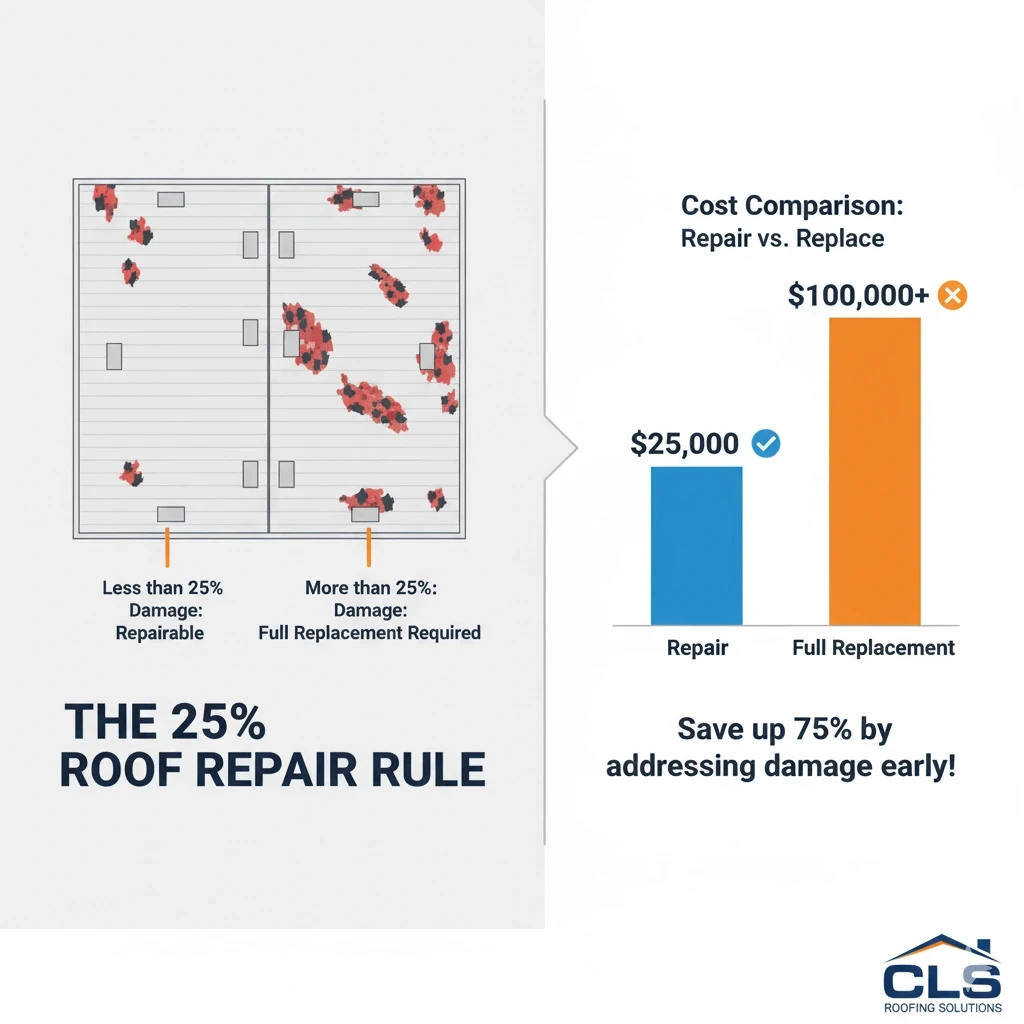
Open seams, punctures and flashing failures can usually be repaired by cleaning the membrane and heat-welding a TPO patch. Repair is the right call when damage is limited and the insulation is dry. When the membrane is brittle, shrinking or failing in many places, replacement or re-cover is the better investment. Learn more on our TPO roofing services page.
Questions to ask any TPO contractor
What membrane thickness and attachment method are you quoting, and why?
Is this a tear-off or a re-cover, and what did the moisture survey show?
What is the manufacturer warranty term, and is it a full system warranty?
What is your workmanship warranty? (CLS provides a 12-year workmanship warranty.)
Who performs the work: in-house crews or subcontractors?
Are you licensed as a Florida roofing contractor, and is the product approved for my county?
How to get an accurate TPO quote
Schedule a roof assessment with drone documentation and moisture readings.
Review the condition report and decide between repair, re-cover and tear-off.
Get a written proposal with membrane, attachment, insulation, details and unit prices.
Compare bids on the same scope, not just the total.
Why cheap TPO bids fail early
Most early TPO failures come from details, not the membrane. Seams that were not fully welded, flashings that were not reinforced, fasteners spaced wider than the approved system, and wet insulation left in place under a re-cover all lead to leaks within a few years. A bid that saves money by skipping a moisture survey, using thinner membrane than the warranty requires or leaving out edge-metal upgrades often costs more over the life of the roof.
Re-cover vs tear-off for TPO
A TPO re-cover goes over an existing roof after a cover board or insulation layer is installed. It is a good option when the existing roof is dry, the deck is sound and the building does not already have the maximum layers allowed by code. Tear-off is the right path when the moisture survey finds widespread wet insulation, when the deck needs work, or when you need to correct drainage with tapered insulation from the deck up. Both paths can carry full manufacturer warranties when installed to the manufacturer's specification.
Maintaining a TPO roof
Inspect at least twice a year and after major storms.
Keep drains, scuppers and gutters clear.
Check seams and flashings at curbs, walls and rooftop units.
Install walkway pads where techs service equipment.
Repair punctures promptly with welded patches.
Keep records: many warranties require documented maintenance.
TPO for different building types
On warehouses and distribution centers, TPO's value over large areas makes it a default choice. On retail centers and offices, mechanically attached or adhered TPO keeps costs controlled while tenants stay open. On condos and multifamily buildings, thicker membranes and walkway protection help with foot traffic from maintenance staff. On restaurants, TPO is often paired with PVC in grease exposure zones. Each case changes the specification, and the specification changes the price.
Frequently asked questions
What is the best TPO thickness for South Florida?
60 mil is a common choice; 80 mil is worth considering for high-traffic roofs, long warranty terms or extra durability.
How long does a TPO installation take?
Most commercial TPO roofs take from a few days to a few weeks, depending on size, tear-off and weather.
Is TPO good for hurricanes?
Yes, when the system is installed to the wind rating required for your building and county. In the HVHZ, products must carry a Miami-Dade NOA and be installed exactly as approved.
Can TPO go over an existing roof?
Often, if the existing roof is dry and code allows another layer. A moisture survey confirms it.
Does a white TPO roof lower cooling costs?
A white, reflective roof absorbs less heat than a dark roof, which can reduce cooling load in South Florida's climate. Results depend on insulation and building use.
Want a second set of eyes on your roof? Schedule a roof inspection with drone documentation and a written report, request roof service, or call our 24/7 line at (561) 207-7693.